
Brazil
Environmental Law and Climate Change

You are viewing part of the Law and Climate Atlas
Introduction
Brazil’s approach to environmental protection is deeply rooted in its Constitution, which recognizes the right to an ecologically balanced environment as a fundamental right. This constitutional status places environmental protection on the same level as other fundamental rights, such as freedom and equality, highlighting its importance for the well-being and healthy quality of life of the population.
The relationship between Brazilian environmental law and international climate agreements, such as the United Nations Framework Convention on Climate Change (“UNFCCC”) and the Paris Agreement, further reinforces Brazil’s commitment to global environmental challenges. These agreements, internalized through decrees, play a crucial role in the formulation of national policies and actions aimed at mitigating climate change and promoting sustainable development.
Given the configuration of Brazilian emissions, the largest share of which comes from the Land Use, Land Use Change and Forestry (“LULUCF”)[1] sector, Brazilian environmental legislation, at the federal, state and municipal levels, offers a comprehensive framework for the conservation of natural resources, pollution control, water resources management and tackling climate change in its two main axes: mitigation and adaptation. Brazil also has relevant jurisprudence that has shaped its environmental and climate normative framework.
Constitutional status
One of the main characteristics of Brazilian environmental law is the constitutional status conferred on environmental protection. The Constitution of the Federative Republic of Brazil (“Federal Constitution”) has a chapter entirely dedicated to the environment, and Article 225 establishes the right to an ecologically balanced environment as an asset of common use and essential to a healthy quality of life, with both government and community having the duty to defend and preserve it for present and future generations.
Thus, the right to an ecologically balanced environment is considered a fundamental right, since it is an asset without which the human person cannot be fulfilled, live together or, sometimes, even survive.[2] Therefore, the Federal Constitution places this right on the same level as other rights such as freedom and equality.
Climate protection, in turn, is not expressly provided for in the Federal Constitution. However, it can be contemplated by the protection conferred on the essential ecological processes mentioned in paragraph 1 of Article 225 – among which the climate may be included. In this sense, Article 225 has been interpreted by part of the doctrine as the basis for the proposition of the “fundamental right to a clean, stable and safe climate (or to the integrity of the climate system)”, with the aim of granting greater autonomy and legal visibility to climate protection[3]. In addition, the Federal Supreme Court (“STF”) has ruled that international treaties on the environment and climate change are equated with international human rights treaties – as detailed in the chapter below.
Internalization of international treaties on climate and environment in the Brazilian legal system
The Federal Constitution also regulates the relationship between the domestic and international regimes. According to Article 5, §2 and §3, the rights and guarantees expressed in the Constitution do not exclude others arising from international treaties to which Brazil is signatory, which may even be recognized as having special normative status in the Brazilian legal system.
The UNFCCC, in this sense, was internalized in the Brazilian legal system through Legislative Decree No. 1/1994[4] and Decree No. 2,652/1998[5]. The UNFCCC is one of the outcomes of the 1992 Rio Convention, which also resulted in the Convention on Biological Diversity, the Rio Declaration, and Agenda 21.[6]
In addition to being considered a milestone for global climate action, the UNFCCC’s main objective is to stabilize greenhouse gas (“GHG”) concentrations at a level that prevents dangerous anthropogenic interference with the climate system.[7] Especially for developing countries such as Brazil, the UNFCCC is extremely relevant for establishing the principle of common but differentiated responsibilities, which assigns greater responsibility to developed countries (Annex I) to undertake efforts to combat climate change, considering that developed countries are also historically the most responsible for its intensification through higher historical GHG emissions.
The Paris Agreement is another milestone of international environmental and climate law that was internalized in the Brazilian legal system through Legislative Decree No. 140/2016[8] and Decree No. 9,073/2017.[9] Just like the UNFCCC, the Paris Agreement has a “supralegal” hierarchy – i.e., it is above ordinary legislation, but below the Federal Constitution.
This hierarchical status was conferred by a decision of the STF in the judgment of the Allegation of Non-Compliance with a Fundamental Precept (“ADPF”) 708. In that ruling, the Court held that international treaties related to the environment and climate change should be considered human rights treaties.[10] It is worth noting that, in order to establish this interpretation builds upon the precedent set in RE 466.343/SP, decided in 2008, in which the Court recognized for the first time that international human rights treaties have supralegal status within the Brazilian legal system.[11]
ADPF 708 was filed in 2020 by several political parties after the contingency of the amounts of the Climate Fund since 2019 by the Union. The lawsuit was upheld on July 1, 2022, when the STF recognized that the contingency of the amounts of the Climate Fund violates the Federal Constitution and Brazil’s international commitments under international treaties on the environment and climate change. As a result, the case has become a landmark in climate litigation in Brazil.[12]
Principles of environmental law and climate change
Another peculiarity of the Brazilian environmental and climate legal regime is the application of legal principles in the interpretation of environmental legislation and, consequently, their use in judicial decisions, including in cases of climate change litigation.[13] Some of the principles of Brazilian environmental and climate law that deserve to be highlighted are:
- Sustainable Development: Provided for in the UNFCCC, in the National Environmental Policy (“PNMA”) (Law No. 6,938/1981, Article 4, I)[14] and in the National Policy on Climate Change (“PNMC”) (Article 3 of Law No. 12,187/2009).[15] It implies the compatibility between the protection of the environment and the climate system with economic and social development;
- Precaution: Provided for in the UNFCCC (Article 3, item 3) and in the PNMC (Article 3). This principle is applied to ensure that the absence of scientific certainty is not used as a justification for delaying measures aimed at addressing climate change. In addition, it is also used to prevent the implementation of activities about which there are scientific uncertainties and risk of irreversible damage;[16] and
- Polluter Pays: Provided for in the PNMA (Article 4, item VII, of Law No. 6,938/1981). It is applied to ensure the internalization of the costs arising from the use of natural resources. It is worth noting that this principle does not represent a punishment, since it can be applied even in the absence of illegality in the activity of the paying agent.[17] Thus, the principle cannot be invoked to exempt the polluter from liability for the damage caused.[18] As GHG emission is one of the oldest examples of externality, the climate version of this principle could be called “emitter pays”, with the aim of holding GHG emitters accountable and promoting the internalization of the climate costs generated by their activities.[19]
- Principle of non-regression: An emerging principle in environmental law, present in some treaties such as the Escazú Agreement (Article 3, item c) and the draft EU-Mercosur trade agreement, and some argue implicit in Article 225 of the Federal Constitution.[20] The principle prohibits governments from weakening current levels of environmental protection.
Competence in environmental matters
According to the Federal Constitution, all federative entities (the Union, States and Municipalities) can legislate on the conservation of natural resources, environmental protection and pollution control (Article 24, item VI). It is up to the Union to establish general rules (Article 24, §1), while the States and Municipalities may legislate in a supplementary manner to federal legislation, when applicable (Article 24, §2 and Article 30, item II). Thus, state and municipal legislation can only expand environmental protection, never weaken the general standards established by federal legislation.
Complementary Law No. 140/2011,[21] in turn, regulates the administrative actions of the federative entities with regard to environmental protection and pollution control. In its articles 7 to 10, this Law establishes which bodies are competent to conduct environmental licensing processes based on the spatial delimitation of the impacts of the licensed activities, as well as which bodies have the competence to inspect and apply sanctions in case of non-compliance with environmental standards.
Based on this, an overview of federal environmental legislation is presented below, which represents the general foundations of Brazilian environmental and climate law.
Major Federal Legislation
National Environmental Policy
Law No. 6,938/1981 established the PNMA. Its principles and objectives are defined in Articles 2 and 4, respectively.[22] In addition, the PNMA also creates the National Environmental System (“SISNAMA”), composed of federal, state, and municipal bodies and entities responsible for the protection and improvement of environmental quality (Article 6); and the National Council for the Environment (“CONAMA”), an advisory and deliberative body responsible for issuing general rules and criteria applicable to the control of potentially polluting activities (Article 8).
The instruments of the PNMA (Article 9) include the environmental impact assessment (EIA), the environmental licensing of potentially polluting activities, the federal technical register of activities and the national system of information on the environment.
The PNMA also introduces the concept of “polluter” as “the individual or legal entity, under public or private law, responsible, directly or indirectly, for an activity that causes environmental degradation” (Article 3, IV). The PNMA also assigns to the polluter strict and joint liability for environmental damage, being subject to the payment of compensation or reparation for the damage regardless of fault (Article 14, §1). Thus, in Brazilian law, civil liability for environmental damages is objective, and joint and several when there is more than one polluter, whether direct or indirect, and propter rem, meaning it is intrinsically linked to the property– an understanding widely recognized by the Superior Court of Justice (“STJ”) in the judgment of “Repetitive Theme No. 1204”[23] and in Precedent No. 623.[24] In addition, it is also necessary to highlight that the case law of STF has established that the claim for reparation of environmental damage is not subject to statute of limitations. According to the understanding initially established within the scope of RE 654.833/SP and “STF Theme 999”[25] and later reinforced by RE 1.427.694/SC and “STF Theme 1.268”,[26] the reparation of the environment is considered as an inalienable fundamental right unavailable in the Brazilian legal system and, because of this, is not subject to a statute of limitations. Thus, according to Brazilian jurisprudence, it is possible to request the repair of environmental damage at any time after its configuration.
Also, the Brazilian civil liability regime has also evolved significantly in relation to climate change, with the emergence of several lawsuits with claims for compensation for climate damage – especially those resulting from illegal deforestation. By 2024, there were 24 climate change litigation lawsuits whose plaintiffs sought reparation for climate damage, characterized as illegal GHG emissions that contribute to worsening climate change.[27]
Among these lawsuits, the case “IBAMA vs. Dirceu Kruger” (Public Civil Action No. 1037196-19.2023.4.01.3200) stands out,[28] in which the 1st Federal Court of the Judicial Section of Amazonas recognized climate damage as a kind of environmental damage and granted an injunction to decree the unavailability of the defendant’s assets in the amount of 292 million Brazilian reais, suspend the defendant’s access to credit lines in official financial institutions, and to determine the implementation of carbon sinks. The decision recognized the presence of the requirements of a prima facie case and periculum in mora, pursuant to Article 300 of the Brazilian Code of Civil Procedure (Law No. 13,105/2015).[29] At the time of drafting this chapter, no appeals had been filed, and the process was awaiting the beginning of the investigation phase.
National Climate Change Policy
With regard to the specific legal framework on climate change, Law No. 12,187/2009 establishes the PNMC. Like the PNMA, the PNMC also establishes a series of principles (Article 3) and objectives (Article 4). However, the PNMC differs in that it also provides for its guidelines (Article 5), which consist of: (i) commitments assumed by Brazil under the UNFCCC and other international instruments on climate change to which it is a signatory; (ii) mitigation actions; (iii) adaptation actions; and (iv) the participation of the public and private sectors in the formulation and execution of climate policy, among others.
Mitigation
Among the mitigation measures implemented under the PNMC, the creation of “RenovaBio” and the “Brazilian Greenhouse Gas Emissions Trading System” (“SBCE”) deserve to be highlighted.
The SBCE consists of a compliance carbon market in Brazil and was established by Law No. 15,042/2024.[30] It adopts a “cap-and-trade” model, whereby an overall emissions ‘budget’ is defined and distributed among regulated agents through “permissions”. The SBCE covers all sectors of the Brazilian economy, except for the primary agricultural production (Article 1, §2) and waste and effluents disposal facilities, when demonstrably adopting systems and technologies for the neutralization of their emissions (Article 30, § 3). Individuals or legal entities responsible for sources or facilities that emit more than 25,000 tCO₂e/year are subject to reporting and monitoring obligations and demonstrating periodic compliance with the environmental obligations that will be defined in the National Allocation Plan, through the ownership of SBCE assets equivalent to their net emissions. (Article 30, II), while those responsible for sources or facilities that emit more than 10,000 tCO₂e/year are subject only to monitoring and reporting (Article 30, I).
The SBCE also has points of intersection with the environmental and traditional community agendas,[31] since its principles include: (i) the promotion of sustainable development; (ii) the conservation and restoration of native vegetation and aquatic ecosystems; and (iii) the guarantee of the rights and autonomy of indigenous peoples and traditional communities (Article 4).
It is also worth mentioning that Law No. 15,042/2024 provides for the voluntary carbon market in Brazil (Article 42) and regulates the ownership of carbon credits (Article 43). In addition, it establishes the legal nature of a security for carbon credits when traded in the financial and capital markets (Article 14). Currently, the SBCE is in the process of structuring its governance and defining its regulatory agenda, as coordinated by the Federal Government in partnership with the World Bank.[32]
Finally, Law No. 13,576/2017[33] institutes the National Biofuels Policy (“RenovaBio”), which aims to expand the production and use of biofuels in the Brazilian energy matrix, contributing both to the reduction of GHG emissions (art. 1, II), and to the country’s energy security (Article 2, I). RenovaBio establishes obligations only for fuel distributors who must comply with mandatory emission reduction targets (Articles 6 and 7). These goals must be met through the acquisition of Decarbonization Credits (CBIOs) (Article 5, V), which are issued by duly authorized and certified biofuel producers or importers (Article 5, VII).
Adaptation
Regarding adaptation, the Federal Government is developing the Climate Change Adaptation Plan[34] with the objective of reducing vulnerability to adverse impacts resulting from climate change. This plan includes the National Adaptation Strategy, structured in 16 sectoral plans, presented for public consultation in October 2024.[35]
It is worth noting, however, that in 2016 the National Adaptation Plan (“PNA”) had been instituted, which covers 11 sectors in its scope – Agriculture, Water Resources, Food and Nutrition Security, Biodiversity, Cities, Disaster Risk Management, Industry and Mining, Infrastructure, Vulnerable Peoples and Populations, Health, Coastal Zones.[36] According to the closing report published in 2020, 92% of the goals proposed by the PNA were the subject of some type of action during its execution period, with the water resources sector having the highest number of measures implemented – about 35.[37]
In addition, driven by the floods that hit the state of Rio Grande do Sul in 2024, the Federal Government published Law No. 14,904/2024,[38] which establishes guidelines for the preparation of climate change adaptation plans at all levels: federal, state, regional, municipal, and local.[39] The guidelines of the Adaptation Plans include the identification, evaluation and prioritization of measures aimed at disaster response; the reduction of vulnerability and exposure to the adverse effects of climate change (Article 2, I). In addition, the priority areas are defined in Article 3 and include:
- Urban infrastructure: Covers services and rights related to housing, green areas, transportation, health and education equipment, sanitation, food and nutrition security, water security, and just energy transition, among other elements aimed at socioeconomic development resilient to climate change and the reduction of social inequalities;
- National infrastructure: Comprises communication, energy, transportation, finance, and water infrastructure services, among others considered strategic and essential to the security and resilience of sectors critical to the country;
- Nature-based infrastructure: Covers services relevant to adaptation to the consequences of climate change, aimed at creating resilience and protection of the population, goods and the ecologically balanced environment, in a sustainable manner, with the possibility of simultaneous integration between adaptation and mitigation actions.
Financing
In line with the UNFCCC provisions on climate finance, the PNMC establishes the National Fund on Climate Change (“Climate Fund”) (Article 6), later regulated by Law No. 12,114/2009[40] and Decree No. 9,758/2018.[41] The Climate Fund is managed by the Union and is considered one of the main instruments of the PNMC. Its operation occurs on two fronts, Reimbursable resources, granted through the National Development Bank (“BNDES”); and Non-reimbursable resources, granted directly by the Federal Government, through public notices.[42] In 2024, the Climate Fund reached approximately 13.6 billion Brazilian reais, of which 10 billion Brazilian reais was allocated to reimbursable financing, and the remaining amount to non-reimbursable projects.[43] Since its creation, the Climate Fund has financed more than 70 projects on a non-reimbursable basis.[44]
Another relevant financing instrument is the Amazon Fund, regulated by Decree No. 6,527/2008.[45] The Amazon Fund is intended to receive national and international donations, with non-refundable application, also through BNDES, in activities to prevent, monitor and combat deforestation, and conservation and sustainable use of the Legal Amazon[46] (Article 1). Currently, the Amazon Fund has financed more than 120 projects and allocated more than 3.2 million Brazilian reais. [47] It is considered the largest REDD+ fund[48] in the world.[49] In addition, the Fund is aligned with the REDD+ safeguards established by the Conference of the Parties (“COP”) No. 16 held under the UNFCCC[50] (Cancun Decision 1/16).[51] The Amazon Fund is subject to financial audits and periodic effectiveness evaluations conducted by third parties,[52] which found clear evidence that the fund contributed to the reduction of deforestation in the Amazon[53].
Water Resources
According to a report published in 2024 by the National Water and Basic Sanitation Agency (“ANA”),[54] climate change introduces significant uncertainties in water availability in the country, by altering the dynamics of hydrological cycles and increasing the frequency and intensity of critical events. Thus, climate change requires the consideration of uncertain futures, which contrasts with the traditional risk analysis used in water resource plans – based only on past events.[55]
Based on the evaluation of different future scenarios, ANA identified a predominance of scenarios that indicate a reduction in flows and water availability in the North and Northeast regions of Brazil.[56] On the other hand, the South region presents a predominance of scenarios with increased flows and availability, associated with a higher frequency of floods.[57]
Law No. 9,433/1997[58] establishes the National Water Resources Policy (“PNRH”) and creates the National Water Resources Management System – of which ANA is part as the federal agency responsible for implementing the PNRH, together with state agencies and councils. Although climate change is not expressly mentioned in the PNRH, the Law provides for provisions and instruments that are relevant to the management of water resources throughout the national territory. Among the objectives of the PNRH are to ensure the necessary availability of water to current and future generations, in quality standards appropriate to their respective uses (Article 2, I), and to prevent and defend against critical hydrological events, of natural origin or resulting from the inappropriate use of natural resources (Article 2, III). Among the main instruments of the PNRH, the Water Resources Plan and the Granting of Rights to Use Water Resources stand out.
The Water Resources Plan aims to guide the management of water resources in a specific river basin, establishing goals and actions to ensure the availability and quality of water. This plan must consider the physical, biotic, demographic, economic, social and cultural characteristics of the region, in addition to being integrated into regional, state and national planning (Article 5, I). The National Water Resources Plan 2022–2040[59] is the current guiding document for the implementation of the PNRH at all levels – federal, state, municipal, and in the Federal District, as well as in their respective river basins.
The Granting of Rights to Use Water Resources consists of permission for the use of water, with the objective of ensuring quantitative and qualitative control of uses and guaranteeing the right of access to this resource. The grant is necessary for uses that may alter the quantity or quality of the available water, such as abstraction, diversion, discharge of effluents, among others (Article 5, III). Climate change may even imply the partial or total suspension of grants, permanently or for a certain period, if there is an urgent need for water to face emergency situations, including those resulting from adverse weather conditions (Article 15, III).
Forests and protected areas
Considering the profile of Brazil’s GHG emissions mentioned above, it is extremely relevant to highlight some of the legal instruments aimed at forest protection in the Brazilian legal system. Examples include the Forest Code (Law No. 12,651/2012)[60] and the National System of Nature Conservation Units – SNUC (Law No. 9,985/2000).[61] Both consist of legal norms applicable throughout the national territory and guide the actions of environmental agencies at all federative levels. These instruments, together with state and municipal standards, establish forest protection standards that must be observed by public and private agents, in rural and urban areas.
These mechanisms are fundamental for climate change mitigation, as they enable efforts to combat deforestation– which is the main source of GHG emissions in Brazil. As illustrated in Figure 1[62], the LULUCF sector reached its peak emissions in 2004 (just over 2,500,000 ktCO₂e) and its lowest historical level in 2012 (approximately 200,000 ktCO₂e). Since then, emissions have returned to growth, with a slight indication of a decrease in 2022.
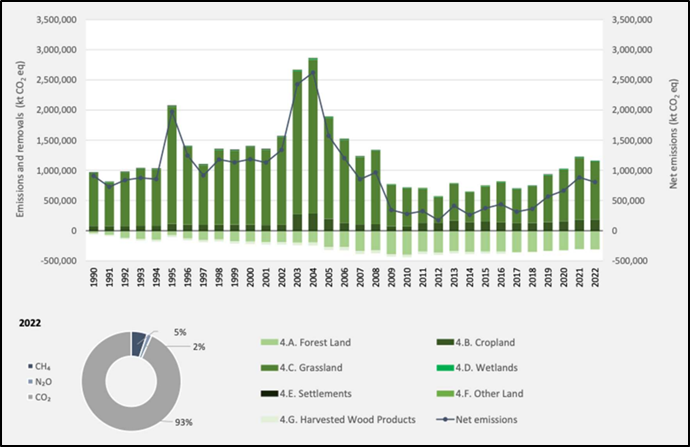
| Figure 1: Emissions from the Land Use, Land Use Change and Forestry (LULUCF) sector, in kt CO² and, by subsector, from 1990 to 2022. Source: National Emissions Inventory (“NIR”), 2024, p. 309. |
The Forest Code establishes general rules on the protection of vegetation, including provisions on Permanent Preservation Areas and Legal Reserve areas; forest exploitation, the supply of forest raw materials, the control of the origin of forest products and the control and prevention of forest fires. In addition, the Forest Code contains express provisions on climate change, such as (i) the inclusion of protection of the climate system as one of its principles (article 1-A, sole paragraph, I); (ii) the requirement to analyze climate impacts in the preparation of the National Policy for the Management and Control of Fires (art. 40); and (iii) the provision of climate regulation, sequestration, conservation and increase of carbon stocks as ecosystem services eligible for Payment for Environmental Services (“PES”) (Article 41, I).
Permanent Preservation Areas (“PPAs”) are protected areas, covered or not by native vegetation, with the environmental function of preserving water resources, landscapes, geological stability, biodiversity, gene flow and well-being of human populations (Article 3, II). They include the margins of water bodies, slopes and elevated areas (Article 4). The maintenance of vegetation in APPs is mandatory. In case of suppression, the owner or possessor must promote the restoration, except for legal exceptions (Article 7, §1). The obligation to recompose any vegetation suppressed in an APP is considered propter rem, meaning it is intrinsically linked to the property, and may be required from current and former owners or possessors, according to the understanding consolidated by the STJ in Precedent 623 and in Repetitive Theme 1204 (mentioned above).[63]
The legal reserve (“RL”), on the other hand, consists of a native coverage area that all rural properties are required to maintain, regardless of the existence of APP (Article 12). It is worth noting that rural properties located in the Legal Amazon may be required to maintain LR areas of up to 80% of the total area, if they are located in forest areas (Article 12, I, a).
The Rural Environmental Registry (“CAR”) is considered an instrument of the National Environmental Information System, consisting of the mandatory electronic public registry of rural properties that contains environmental information on rural properties, such as RL and APPs, if they exist (Article 29). Registration in the CAR, which is self-declaratory, must be done upon proof of possession or ownership of the property (Article 29, paragraph 1, II).
The SNUC, in turn, was established by Law No. 9,985/2000 and its main objective is to regulate Conservation Units – territorial spaces with relevant natural characteristics and legally established by the Government with conservation objectives and defined limits (Article 2, I). Although it does not contain express provisions on climate change, the SNUC also establishes standards for environmentally protected areas in a special way, which makes it an essential mechanism to ensure the protection of biodiversity and the climate system.[64]
In all, there are 12 types of Conservation Units divided into two distinct groups: full protection units, whose objective is to preserve nature, allowing only the indirect use of its natural resources, except in cases provided for by law (Article 7, paragraph 1); and sustainable use units, which reconcile nature conservation with the sustainable use of part of their natural resources (Article 7, paragraph 2).
Among the full protection units (Article 8) are: (i) ecological station; (ii) biological reserve; (iii) national park; (iv) natural monument; and (v) wildlife refuge. The regime applicable to each of them is regulated between Articles 9 and 13. The sustainable use units (Article 14) are: (i) environmental protection area; (ii) area of relevant ecological interest; (iii) national forest; (iv) extractive reserve; (v) fauna reserve; (vi) sustainable development reserve; and (vii) private natural heritage reserve; Their regimes are regulated between articles 15 and 21.
Brazil’s Deforestation Prevention and Control Program (“PPCD”) is particularly relevant to the mitigation axis due to the profile of Brazilian GHG emissions. According to the National Emissions Inventory Report (“NIR”) presented to the UNFCCC in 2024, with a base year of 2022, the LULUCF sector is the main source of emissions (39.5%) – followed by the agriculture (30.5%) and industry (5%) sectors.[65] Thus, the fight against deforestation is considered one of the main mitigation strategies in Brazil. Consequently, Decree No. 11,367/2023[66] reinstated the Amazon PPCD (“PPCDAm”), after its repeal in 2019,[67] with the objective of establishing command and control measures aimed at reducing deforestation rates in the Amazon (Article 2). Currently, the PPCDAm is in its 5th Phase,[68] with the goal of achieving zero deforestation by 2030.
[1] Brazil ‘NIR’ (2024, p. 309) <https://unfccc.int/documents/644855> accessed on 31 July, 2025.
[2] Silva, José Afonso, ‘Direito Constitucional Positivo’ (26 ed., Malheiros, 2006, p. 178).
[3] Sarlet, Ingo; Fensterseifer, Tiago. ‘Curso de Direito Ambiental’ (5 ed., Forense, 2025, p. 421) <https://integrada.minhabiblioteca.com.br/reader/books/9788530995478/> accessed on 14 April, 2025.
[4] ‘Legislative Decree No. 1/1994’ < https://www2.camara.leg.br/legin/fed/decleg/1994/decretolegislativo-1-3-fevereiro-1994-358285-publicacaooriginal-1-pl.html> accessed on August 28, 2025.
[5] ‘Decreto nº 2,652/1998’ <https://www.planalto.gov.br/ccivil_03/decreto/d2652.htm> accessed on 16 April, 2025.
[6] UN, ‘Rio 1992’ <https://www.un.org/en/conferences/environment/rio1992> accessed on 16 April, 2025.
[7] UNFCCC, ‘What is the United Nations Framework Convention on Climate Change?’ <https://unfccc.int/process-and-meetings/what-is-the-united-nations-framework-convention-on-climate-change> accessed on 16 April, 2025.
[8] ‘Legislative Decree No. 140/2016’ <https://www2.camara.leg.br/legin/fed/decleg/2016/decretolegislativo-140-16-agosto-2016-783505-publicacaooriginal-150960-pl.html> accessed on August 28, 2025.
[9] ‘Decree No. 9,073/2017′<https://www.planalto.gov.br/ccivil_03/_ato2015-2018/2017/decreto/d9073.htm> accessed on 16 April, 2025.
[10] See the full decision at <https://portal.stf.jus.br/processos/detalhe.asp?incidente=5951856>, accessed on April 16, 2025. With similar provisions, there is also the ADO 59 case, which dealt with the paralysis of the Amazon Fund. See the full decision at <https://portal.stf.jus.br/processos/downloadPeca.asp?id=15360101699&ext=.pdf>, accessed on April 16, 2025.
[11]https://www.stf.jus.br/imprensa/pdf/re466343.pdf . Accessed on September 03, 2025.
[12] Andrade, Danielle coord., ‘Climate change litigation in Brazil: 2024 report’ (Ed. Das Autoras, 2024, p. 51) <https://81fde5d4-675c-45a4-965d-ddaf8ad9b2cd.filesusr.com/ugd/a8ae8a_99af27e396ca4f26a06982652fc60a42.pdf> accessed on 16 April, 2025.
[13] Nusdeo, Ana Maria; Martinez, Matheus, ‘Strategic climate change litigation: a catalyst for the evolution of the principles of environmental law in Brazil’ (Revista de Derecho Ambiental, [S. l.], v. 1, n. 21, p. 117–142, 2024). <https://revistaderechoambiental.uchile.cl/index.php/RDA/article/view/72507> accessed on 16 April, 2025.
[14] Law No. 6,938/1981′<https://www.planalto.gov.br/ccivil_03/leis/l6938.htm> accessed on 16 April, 2025.
[15] ‘Law No.12,187/2009’ <https://www.planalto.gov.br/ccivil_03/_ato2007-2010/2009/lei/l12187.htm> accessed on 16 April, 2025.
[16] Milaré, Edis. ‘Direito do Ambiente’ (12 ed., Revista dos Tribunais, 2021, p. RB-8.9. E-book) <https://proview.thomsonreuters.com/launchapp/title/rt/monografias/91624456/v12/page/RB-8.9> accessed on 16 April, 2025.
[17] Machado, Paulo Affonso; Aragão, Maria Alexandra, ‘Princípios do Direito Ambiental’ (JusPodivm, 2022, p. 75).
[18] Ibid.
[19] See Note No. 3, p. 315.
[20] Tigre, Maria Antonia; Urzola, Natalia, ‘Developing Brazilian Jurisprudence on the Right to a Healthy Environment’ (Global Network for Human Rights and the Environment), accessed on 13 October 2025 <https://gnhre.org/?p=12454>.
[21]Complementary Law No. 140/2011′ <https://www.planalto.gov.br/ccivil_03/leis/lcp/lcp140.htm> accessed on 16 April, 2025.
[22] “Article 2 – The National Environmental Policy aims to preserve, improve, and restore environmental quality conducive to life, with a view to ensuring conditions for socioeconomic development, national security interests, and the protection of human dignity in the country, in accordance with the following principles: I – government action to maintain ecological balance, considering the environment as a public asset that must be safeguarded and protected for collective use; II – rationalization of the use of soil, subsoil, water, and air; III – planning and supervision of the use of environmental resources; IV – protection of ecosystems, with the preservation of representative areas; V – control and zoning of potentially or effectively polluting activities; VI – incentives for the study and research of technologies aimed at the rational use and protection of environmental resources; VII – monitoring of environmental quality; VIII – recovery of degraded areas; IX – protection of areas threatened by degradation; X – environmental education at all levels of education, including community education, with the aim of enabling active participation in the defense of the environment. See Note No. 14.
[23] Similar to Common Law precedents, the STJ establishes repetitive issues with theses that must be applied to cases in which the same question of law is discussed. The choice of the case to be judged as repetitive may fall on a case: a) referred by the courts of origin as representative of the controversy (Code of Civil Procedure, article 1,036, paragraph 1); b) selected by the President of the Precedents and Class Action Management Committee as representative of the controversy; or c) in an appeal distributed to a rapporteur in the STJ. See <https://processo.stj.jus.br/repetitivos/temas_repetitivos/pesquisa.jsp?novaConsulta=true&tipo_pesquisa=T&sg_classe=REsp&num_processo_classe=1953359>, accessed on April 16, 2025, and <https://www.stj.jus.br/sites/portalp/Precedentes/informacoes-gerais/recursos-repetitivos>, accessed on April 16, 2025.
[24] The precedents are similar to normative acts that summarize the consolidated understanding of the Brazilian Superior Courts, such as the STF and the STJ. See, for example, Precedent No. 623 at <https://www.stj.jus.br/publicacaoinstitucional/index.php/sumstj/article/viewFile/5052/5179>, accessed on April 16, 2025, and <https://www.stj.jus.br/sites/portalp/Paginas/Comunicacao/Noticias/2024/16102024-Nova-edicao-do-Livro-de-Sumulas-ja-esta-disponivel-para-consulta-e-download.aspx>, accessed on April 16, 2025.
[25] See more information on the case <https://portal.stf.jus.br/processos/detalhe.asp?incidente=4130104> accessed on September 01, 2025.
[26] See more information about the case <https://portal.stf.jus.br/noticias/verNoticiaDetalhe.asp?idConteudo=514714&ori=1> accessed on September 01, 2025.
[27] Moreira, Danielle (coord.), ‘Panorama da Litigância Clima no Brasil’ (Rio de Janeiro, PUC-Rio, 2024, p. 18) <https://juma.jur.puc-rio.br/_files/ugd/a8ae8a_98130c7a71f542e1949db1b2d8646e35.pdf> accessed on 20 April, 2025.
[28] See more information about the case ‘IBAMA vs. Dirceu Kruger’ <https://litigancia.biobd.inf.puc-rio.br/visualizacao_caso/418/0/> accessed on 20 April, 2025.
[29] ‘Law No. 13,105/2015’ <https://www.planalto.gov.br/ccivil_03/_ato2015-2018/2015/lei/l13105.htm> accessed on 16 April, 2025.
[30] ‘Law No. 15,042/2024’ <https://www.planalto.gov.br/ccivil_03/_Ato2023-2026/2024/Lei/L15042.htm> accessed on 16 April, 2025.
[31] According to Decree No. 6,040/2007, “traditional communities” are considered “culturally differentiated groups that recognize themselves as such, that have their own forms of social organization, that occupy and use territories and natural resources as a condition for their cultural, social, religious, ancestral and economic reproduction, using knowledge, innovations and practices generated and transmitted by tradition”. See the full text of Decree No. 6,040/2007 <https://www.planalto.gov.br/ccivil_03/_ato2007-2010/2007/decreto/d6040.htm> accessed on September 01, 2025.
[32] Brazil and World Bank, ‘Implementation Roadmap’ (PMI, December, 2024) <https://www.gov.br/fazenda/pt-br/central-de-conteudo/publicacoes/guias-e-manuais/2024/241209-crtlh-implementacao-sbce-v4.pdf> accessed on 16 April, 2025.
[33] ‘Lei nº 13,576/2017’ <https://www.planalto.gov.br/ccivil_03/_ato2015-2018/2017/lei/l13576.htm> accessed on 16 April, 2025.
[34] See more information about the Climate Adaptation Plan <https://www.gov.br/mma/pt-br/composicao/smc/plano-clima/plano-clima-adaptacao> accessed on April 16, 2025.
[35] See more information about the public consultation <https://brasilparticipativo.presidencia.gov.br/processes/planoclima/f/315/> accessed on 16 April, 2025
[36] See more information about the PNA/2016 <https://www.gov.br/mma/pt-br/assuntos/mudanca-do-clima/plano-nacional-de-adaptacao> accessed on April 16, 2025.
[37] Brazil ‘Final Report – PNA’ <https://www.gov.br/mma/pt-br/assuntos/mudanca-do-clima/clima/arquivos/final-report_en_web.pdf> accessed on 16 April, 2025.
[38] ‘Law No. 14,904/2024’ <https://www.planalto.gov.br/ccivil_03/_Ato2023-2026/2024/Lei/L14904.htm> accessed on 16 April, 2025.
[39] Benhke, Emily, ‘Congress has a central role in controlling climate adaptation’ (Senado Notícias, 14 June 2024) <https://www12.senado.leg.br/noticias/materias/2024/06/14/congresso-tem-funcao-central-para-o-controle-e-a-adaptacao-climatica> accessed on 16 April, 2025.
[40] Law No. 12,114/2009′ <https://www.planalto.gov.br/ccivil_03/_ato2007-2010/2009/lei/l12114.htm> accessed on 16 April, 2025.
[41] ‘Decree No. 9,758/2018’ <https://www.planalto.gov.br/ccivil_03/_Ato2015-2018/2018/Decreto/D9578.htm> accessed on 16 April, 2025.
[42] See more information about the Climate Fund <https://www.gov.br/mma/pt-br/assuntos/mudanca-do-clima/fundo> accessed on 16 April, 2025.
[43] See the 2024 report of the Climate Fund 2024 <https://www.gov.br/mma/pt-br/composicao/secex/dfre/fundo-nacional-sobre-mudanca-do-clima/RelatrioFNMCMMA2024.pdf> accessed on 16 April, 2025.
[44] See the list of non-reimbursable projects <https://www.gov.br/mma/pt-br/composicao/secex/dfre/fundo-nacional-sobre-mudanca-do-clima/copy_of_ProjetosFNMC2011a2024DadosAbertos.pdf> accessed on 16 April, 2025.
[45] ‘Decreto nº 6,527/2008’ <https://www.planalto.gov.br/ccivil_03/_ato2007-2010/2008/decreto/d6527.htm> accessed on 28 April, 2025.
[46] The “Legal Amazon” comprises the Brazilian states: Acre, Amazonas, Amapá, Mato Grosso, Pará, Roraima and Rondônia, Tocantins and part of Maranhão. See more information about the Legal Amazon <https://www.gov.br/sudam/pt-br/acesso-a-informacoes/institucional/legislacao-da-amazonia> accessed on September 03, 2025.
[47] See more information about the Amazon Fund <https://www.fundoamazonia.gov.br/pt/home/> accessed on 28 April, 2025.
[48] As established by Article 2, XXIX, Law No. 15,042/2025, the Brazilian legal system provides the following concept for “REDD+”: “policy approaches, positive incentives, projects or programs aimed at reducing emissions from deforestation and forest degradation and the role of conservation, sustainable forest management and the increase of forest carbon stocks”. See the full text of Law No. 15,042/2025 <https://www.planalto.gov.br/ccivil_03/_ato2023-2026/2024/lei/L15042.htm> accessed on September 01, 2025.
[49] BNDES, ‘Amazon Fund: Activity Report 2023’ (2024, p. 11) <https://www.fundoamazonia.gov.br/export/sites/default/pt/.galleries/documentos/rafa/RAFA_2023_port.pdf> accessed on 28 April, 2025.
[50] The COP was established as the supreme body responsible for monitoring the implementation of the UNFCCC, in addition to acting as a permanent forum for negotiations (UNFCCC, art. 7) <https://unfccc.int/process-and-meetings/what-is-the-united-nations-framework-convention-on-climate-change> accessed on September 1, 2025.
[51] Ibid, p. 64.
[52] See more information on the effectiveness of the Amazon Fund <https://www.fundoamazonia.gov.br/pt/monitoramento-e-avaliacao/avaliacoes-externas/> and its respective financial audits <https://www.fundoamazonia.gov.br/pt/transparencia/auditorias/> accessed on 28 April, 2025.
[53] See Note 43, p. 70.
[54] ANA, ‘Impact of Climate Change on Brazil’s Water Resources’ (Brasília, 2024, p. 15). <https://metadados.snirh.gov.br/geonetwork/srv/api/records/31604c98-5bbe-4dc9-845d-998815607b33/attachments/Mudancas_Climaticas_25012024.pdf> accessed 20 April 2025.
[55] Ibid.
[56] Ibid, p. 85.
[57] Ibid.
[58] ‘Law No. 9,433/1997’ <https://www.planalto.gov.br/ccivil_03/leis/l9433.htm> accessed on 16 April, 2025.
[59] See more information about the Water Resources Plan 2022-2040 <https://www.gov.br/mdr/pt-br/assuntos/seguranca-hidrica/plano-nacional-de-recursos-hidricos-1> accessed on 20 April, 2025.
[60] ‘Law No. 12,651/2012’ <https://www.planalto.gov.br/ccivil_03/_ato2011-2014/2012/lei/l12651.htm> accessed on 16 April, 2025.
[61] ‘Law No. 9.985/2000’ <https://www.planalto.gov.br/ccivil_03/leis/l9985.htm> accessed on 16 April, 2025.
[62] See Note No. 1.
[63] See Notes 54 and 55.
[64] See Note No. 3, p. 977.
[65] Brazil ‘NIR’ (2024, p. 309) <https://unfccc.int/documents/644855> accessed on 16 April, 2025.
[66] ‘Decree No. 11,367/2023’ <https://www.planalto.gov.br/ccivil_03/_ato2023-2026/2023/decreto/D11367.htm> accessed on 16 April, 2025.
[67] The PPCDAm stoppage was the subject of ADPF 760, filed with the STF on September 29, 2020. In the final decision, the STF understood that the omission in the implementation of the PPCDAm violates the Federal Constitution and determined that the Federal Government cease this omission and implement the plan See the full decision at <https://portal.stf.jus.br/processos/downloadPeca.asp?id=15368120159&ext=.pdf>, accessed on April 16, 2025.
[68] See the 5th Phase of the PPCDAm <https://www.gov.br/mma/pt-br/assuntos/controle-ao-desmatamento-queimadas-e-ordenamento-ambiental-territorial/controle-do-desmatamento-1/amazonia-ppcdam-1/ppcdam_5_en.pdf> accessed on 16 April, 2025.
 Slingshot